Detailed Content
History and Architecture: A Flourishing Port Forgotten by Time As early as the 16th century, Hoi An was an important stop on the Silk Road, attracting a large number of merchants from China, Japan, the Netherlands, and India to settle. Later, due to river siltation, the port's status was gradually replaced by Da Nang, but because of this, Hoi An escaped the ravages of the Vietnam War and modern demolitions, preserving the city's appearance from the 17th century to this day. It was listed as a UNESCO World Heritage Site in 1999.
Must-See Highlights
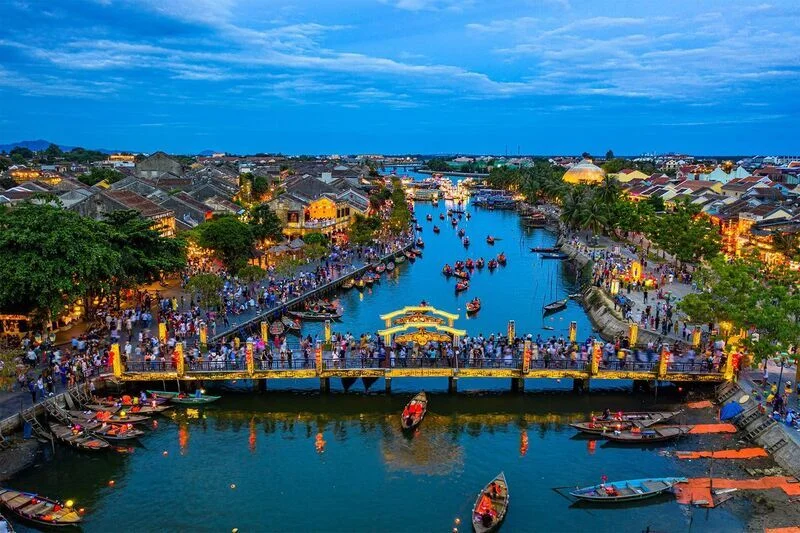
Japanese Covered Bridge: Built in the 1590s, it is a landmark of Hoi An. This bridge connects the Chinese district with the Japanese district of that time, and it is dedicated to the deity Bac De Tran Vu, featuring a unique design. (Note: Recently completed renovation, the appearance may be newer).
Chinese Assembly Halls: Hoi An has many magnificent assembly halls, among which Phuc Kien Assembly Hall is the most splendid, dedicated to the goddess Mazu, with a deep courtyard and thriving incense offerings; Quang Trieu Assembly Hall is famous for its unique dragon-shaped fountain.
Tan Ky Old House: This is a merchant's old house with a history of two hundred years, perfectly showcasing the fusion of Chinese, Japanese, and Vietnamese architectural styles, with marks on the walls indicating the heights of past floods, witnessing the rise and fall of Hoi An.
Hoi An Lantern Night View: See the yellow walls during the day, and the lanterns at night. After dark, the entire ancient town does not turn on street lights, relying only on thousands of handmade silk lanterns for illumination, while the Thu Bon River is filled with floating water lanterns for blessings, creating an extremely dreamy scene.
Tailoring: Hoi An is the capital of "fast fashion tailoring." There are hundreds of tailor shops in town where you can order a fitted suit, dress, or leather shoes at a low price within 24 hours.
Visiting Tips
Lunar 14th/15th (Full Moon Festival): Every month on the 14th night of the lunar calendar is the famous "Full Moon Lantern Festival." The whole town turns off electric lights, leaving only the glow of lanterns, along with traditional nostalgic games and opera performances, making it the most beautiful moment in Hoi An.
Experience Releasing Water Lanterns: In the evening, many elderly women sell paper water lanterns by the Thu Bon River (approximately 10,000 - 20,000 VND). Taking a small wooden boat to the center of the river to release lanterns for blessings is an essential ritual.
Must-Try Foods: You absolutely cannot miss the three treasures when visiting Hoi An:
Cao Lau: Only noodles made with ancient well water from Hoi An are chewy, served with char siu and crispy crackers.
White Rose: Translucent shrimp dumplings that look like clouds.
Fried Wonton: Topped with sweet and sour sauce and ingredients, resembling Vietnamese pizza.