🚨 Emergency Broadcast Before Departure! Vietnam's travel policies are constantly changing. In addition to accommodations, don't get the visa wrong! Starting from 2025/10/14, Vietnam will implement new regulations for foreign entry, and failure to meet the qualifications may result in being deported on the original flight. 👉 Click here to view the guide: New Entry Regulations and Visa Considerations for Vietnam from 2025/10/14
Introduction: The Urban Legend About "Knocking at Midnight"
When traveling to Vietnam, you must have heard this saying: "In Vietnam, if a foreign guy wants to share a room with a Vietnamese girl, they must show a marriage certificate; otherwise, the police will come to arrest them." Is this true, or is it just an excuse from hotels to avoid trouble? If it's true, why are there still many people sharing their experiences of spending the night with girls online? Today, the VietGo editor will help everyone break down this **"Decree No. 96"** that makes countless male tourists shiver. Understanding the rules of the game will prevent a romantic night from turning into a day trip to the police station.
1. What Does the Law Actually Say? (Hardcore Science)
To get straight to the point: "The law does not say that dating is a crime, but hotels are afraid of being fined, so they strictly enforce it."
According to the decrees issued by the Vietnamese government, although there is no criminal law explicitly stating "unmarried couples sharing a room is a crime," there are very strict management regulations for lodging providers.
Key Legal Provisions
According to Decree No. 96/2016/ND-CP on the conditions for the operation of the administrative management industry for public order
Although this decree was updated in 2016, removing the strong wording from the old version (Decree No. 72/2009/ND-CP) that explicitly stated "a marriage certificate is required to share a room." However! The decree still requires lodging providers to **"ensure that no social evils (such as prostitution) occur on their premises."
Plain Language Explanation: The law no longer explicitly prohibits "dating and sharing a room," but it has shifted the pressure onto hotels. If a hotel allows you to share a room and the police find out you are engaging in "illegal activities," the hotel will face heavy fines or even have their license revoked. Therefore, to protect themselves, 90% of regular hotels (especially those rated 3 stars and above) will still strictly enforce the internal rule of "no marriage certificate, no sharing a room." This is not to make things difficult for you; it's to protect their livelihood.
2. The "Unwritten Rules" of the Real World: 3-Star vs 5-Star
The law is one thing, and reality is another. In Vietnam, whether you can share a room often depends on where you stay.
1. 5-Star / International Chain Hotels (Sheraton, Hyatt, Lotte...)
- Enforcement Level: 100% Strict.
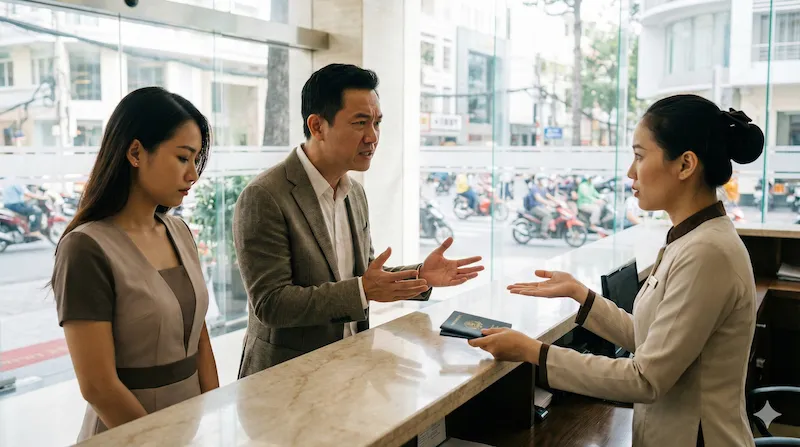
- Do not attempt to challenge the front desk; they will register even a fly that enters. If you bring a Vietnamese girl back, the front desk will politely but firmly ask her to wait in the lobby or request that you book a second room.
2. 3-Star / Local Business Hotels
- Enforcement Level: 50% Depends on Luck.
- Some front desks may turn a blind eye if they receive a "tip," but the risk is that if the police come for a surprise inspection at midnight (usually to catch gambling or drugs and check rooms), you will be in serious trouble.
3. What if I Stay at an Airbnb? (2025 Latest Pitfalls)
Many people might say: "Hotels are too strict, so I can stay at an Airbnb, right?" Wrong! The current Airbnb situation in Vietnam may be an even bigger hidden bomb.
According to Vietnam's latest Housing Law and the enforcement situation for 2024-2025, there are two huge risks you must know:
1. The "Short-Term Rental Ban" for Apartment Buildings (Condo) Currently, Vietnamese law strictly prohibits using "purely residential apartment buildings" for Airbnb short-term rentals. If you book a high-end apartment building in District 4 of Ho Chi Minh City, many of them are actually operating in a gray area.
- Risk: Building security may refuse entry to unfamiliar guests, or the police may conduct focused inspections on these buildings.
2. The Deadly "Temporary Residence Registration (Khai báo tạm trú)" This is the most dangerous point. The law stipulates that when foreigners stay anywhere, the property owner must report to the police within 12 hours.
- Regular Hotels: They collect your passport at check-in and immediately report your stay → Safe.
- Illegally Operating Airbnbs: Hosts who are violating short-term rental regulations are afraid to report your information (for fear of being taxed).
- Consequences: If you happen to encounter a midnight inspection and cannot provide proof of temporary residence, although the main penalty is on the host, you will be taken to the police station for a record, ruining your trip.
💡 Viet-Go recommends: For peace of mind, please choose a "whole house (Villa)" or a legal "serviced apartment," and avoid short-term rental units in large communities.
4. What Happens If You Are "Checked"?
This is not to scare you; although the probability is low, it can really happen.
- Administrative Fines: Both parties will be taken to the police station. If you cannot prove your relationship, you will usually be fined for "not reporting temporary residence as required" or "violating social order."
- Deportation: If money transactions are involved and deemed as prostitution, foreigners may be blacklisted.
- Social Death Scene: Imagine being in your underwear at midnight facing uniformed police and having to call for a translator; this is definitely a memory you do not want to experience.
5. How to Stay Safe?
Sharing this is not to scare everyone, but to hope that everyone "does not step on a landmine due to ignorance." If you are seriously dating a Vietnamese girl or developing a legitimate international friendship, please be sure to honestly report your accommodation.
What if an emergency situation really occurs? If you encounter an inspection during your trip or have communication issues with hotel front desks or hosts, **"language barriers"** are often the main reason small issues become big problems.
At this time, having someone who understands the language is very important. We strongly recommend: when planning such trips, it is best to find a local person who understands both Chinese and Vietnamese to assist with communication. Whether facing an inspection or a hotel dispute, having someone knowledgeable present to accurately convey messages can definitely avoid 90% of unnecessary misunderstandings caused by "not understanding and giving wrong answers."
💡 Conclusion: Vietnam is beautiful, and Vietnamese girls are gentle. But before enjoying romance, it's essential to understand some legal knowledge to play safely and for a long time.
🏛️ Appendix: Legal Provisions Cited (Sources)
1. Decree No. 96/2016/ND-CP
- The official Vietnamese regulations on "conditions for the operation of the administrative management industry for public order." Although the mandatory marriage certificate clause has been removed, the responsibility for lodging providers to prevent social evils remains.
- Official link/search keywords:
Nghị định 96/2016/ND-CP
2. Housing Law 2023
- A new law effective from August 2024, which explicitly restricts apartment buildings (Apartment/Condo) from being used for short-term rentals and other non-residential purposes.
- Official link/search keywords:
Luật Nhà ở số 27/2023/QH15
3. Residence Law 2020
- Stipulates that all guests (including foreigners) must complete temporary residence registration (Khai báo tạm trú) by 23:00 on the same night.
- Official link/search keywords:
Luật Cư trú số 68/2020/QH14
(Disclaimer: This article aims to provide travel information and legal knowledge dissemination and does not encourage or involve any illegal activities.)