Introduction: One of the Countries that Values "Lunar New Year" the Most
If you plan to visit Vietnam during the 2026 Lunar New Year (Tết Nguyên Đán), be sure to prepare yourself mentally. The Vietnamese place even more importance on the Spring Festival than Taiwan.
During this period, Vietnam will experience a nationwide migration and "shutdown." Major cities (like Ho Chi Minh City and Hanoi) will instantly turn into ghost towns, while tourist areas will be overcrowded. Don’t want to step on landmines, have trouble hailing a ride, or inadvertently offend the locals during the New Year? This ultimate guide that integrates **"Survival Rules" , "In-depth Cultural Analysis" and "Food, Drink, and Fun"** is a must-save.
Chapter 1: Survival Rules - Don't Let These Things Ruin Your Trip
Vietnam during the New Year is completely different from usual. Here are the three deadliest "landmines":
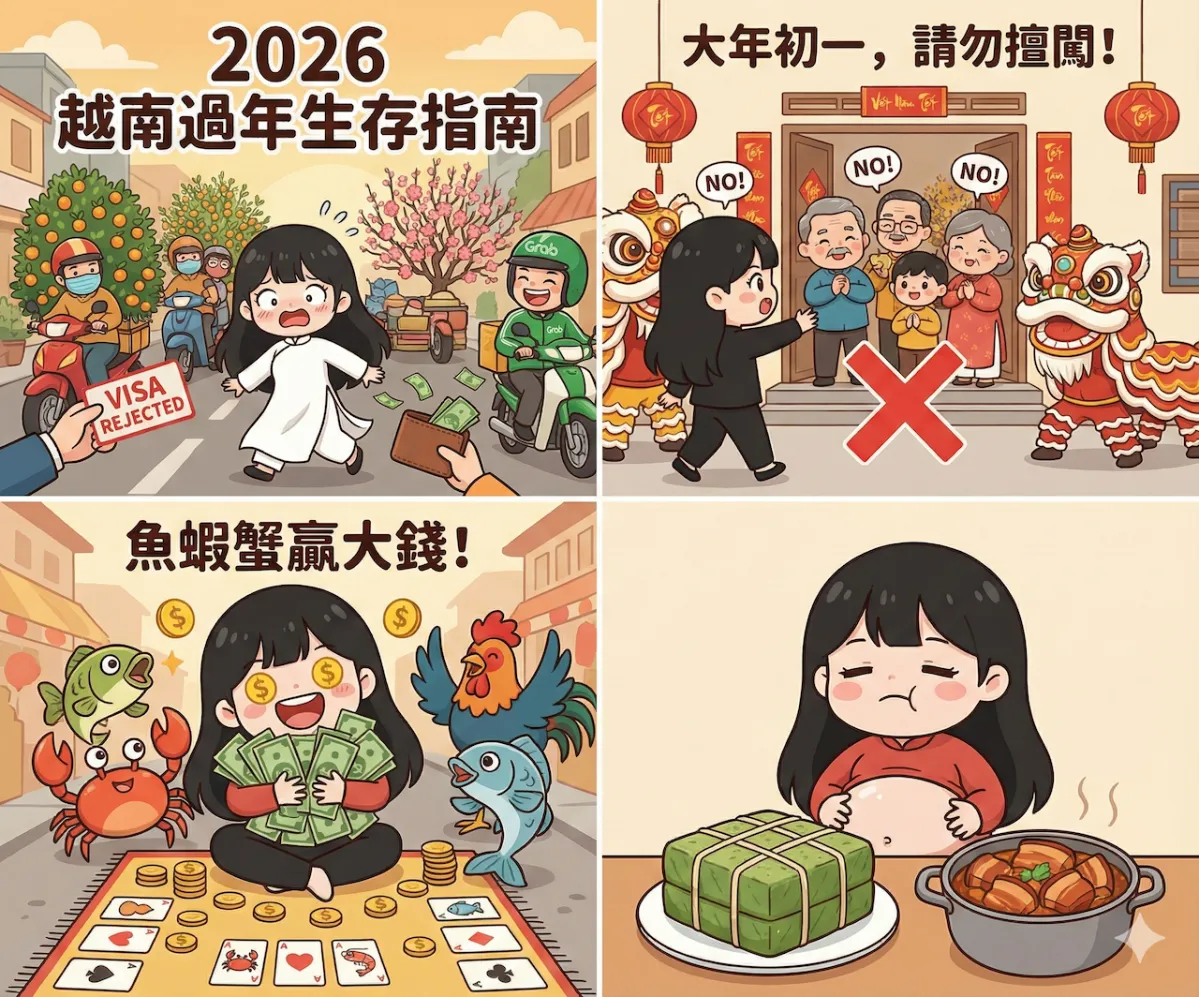
1. Visa: Absolutely Don't Cut It Close!
This is the most important point.
- Situation: The Vietnamese Immigration Department will take a long holiday during the New Year (usually 7-9 days), during which they will completely stop processing visas.
- Risk: If you apply for an electronic visa (E-visa) just 3-5 days before the holiday, it is highly likely that due to the backlog of cases, your visa will not be issued by your departure date, resulting in a direct boarding denial.
- Advice: Be sure to submit your application at least 3 weeks before departure to leave yourself an escape route.
2. Transportation: Price Increases and Difficulty Hailing Rides
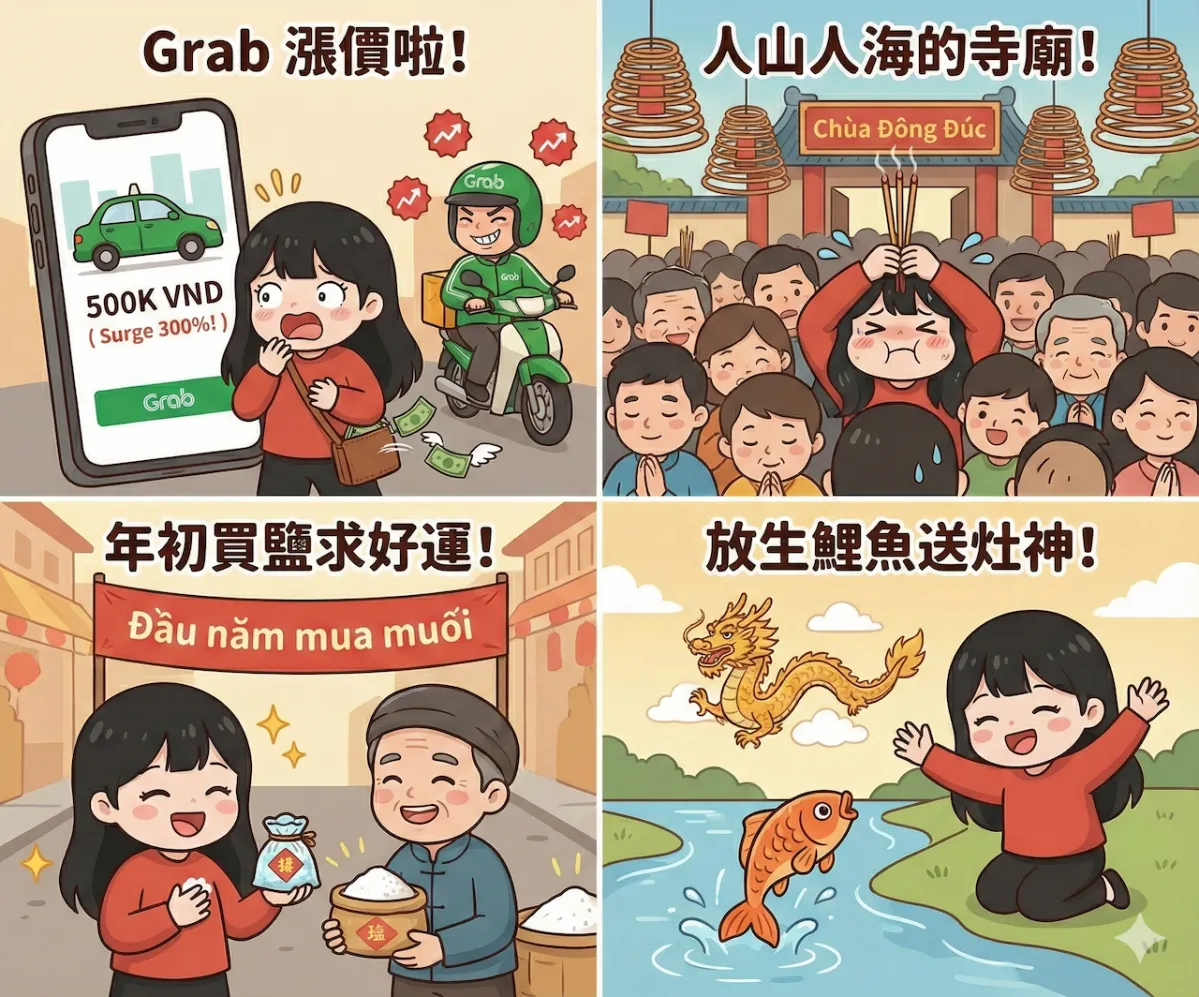
- Grab / Taxi: Drivers return home for the holidays, and under the imbalance of supply and demand, fares usually increase by 30% to 100%, and waiting times can extend from 3 minutes to as long as 20 minutes.
- Long-Distance Transport: Trains, buses, and domestic flights are hard to come by; if you haven't booked a month in advance, you basically won't be able to buy tickets.
3. Food and Stores: Can't Eat Even If You Have Money?
- Famous Restaurants Closed: Many well-known pho shops and traditional snack vendors will be closed from New Year's Eve to the fifth day of the New Year.
- Service Charge Increase: Restaurants that are open (usually chain stores) may post notices on the menu adding a 20% to 30% "New Year Service Charge". This is a legal practice in Vietnam, so please keep smiling and do not argue.
- ATM Cash Withdrawal Issues: On the eve of the holiday, everyone goes to withdraw cash for red envelopes, causing ATMs to frequently run out of cash. Be sure to exchange enough US dollars in Taiwan beforehand.
Chapter 2: Worship and Customs - What Are Vietnamese People Busy With During the New Year?
If you arrive in Vietnam at the end of the twelfth lunar month, you will see some scenes that are very different from Taiwan:
1. January 23: Sending Off the Kitchen God and "Releasing Carp"
- Custom: In Taiwan, people send off the Kitchen God with glutinous rice balls (to keep their mouths shut), but in Vietnam, it is said that the Kitchen God rides a "carp" back to heaven to report.
- Scene: On this day, you will see many Vietnamese carrying bags of water to the riverside or lakeside to release live carp, allowing them to transform into dragons to send the Kitchen God to heaven. This is a very unique cultural spectacle for foreign tourists.
2. First Day of the New Year: Buying Salt (Mua Muối)
- Proverb: There is a Vietnamese saying: "Buy salt at the beginning of the year, buy lime at the end of the year (Đầu năm mua muối, cuối năm mua vôi)."
- Meaning: Salt symbolizes the driving away of evil spirits and represents the "salty" balance of relationships (meaning deep affection and abundance).
- Scene: On the morning of the first day of the New Year, there will be many vendors selling beautifully packaged salt on the streets. Tourists can also buy a packet for good luck, costing only a few thousand Vietnamese dong.
3. Going to the Temple for Blessings (Đi Chùa)
- Like in Taiwan, Vietnamese people also go to temples to pray on the first and fifteenth days of the month. However, be aware that the crowds at Vietnamese temples during the New Year can be overwhelming, and the incense is very strong. If you don't like crowded places, it is advisable to avoid well-known large temples.
Chapter 3: Cultural Differences - A Comparison of New Year Celebrations in Taiwan and Vietnam
Although both celebrate the Lunar New Year, the customs in Vietnam are actually quite different from those in Taiwan. The following table makes it easy to understand:
| Comparison Item | Taiwan New Year (Taiwan) | Vietnam New Year (Vietnam) |
| Must-Eat New Year Dishes | Dumplings (Yuanbao), Rice Cake (Bubbling Up), Long Green Vegetables | Square Sticky Rice Cake/Round Sticky Rice Cake (Bánh Chưng/Tét), Coconut Braised Pork, Bitter Melon Soup (Bitter Ends Sweet) |
| Essential Plants | Orchids, Silver Willow, Narcissus | Peach Blossom (North Vietnam), Yellow Apricot Blossom (South Vietnam), Kumquat Tree (Every household must place a large tree at the entrance) |
| Red Envelope Taboos | Cannot be odd numbers, cannot be sealed | Must Use New Bills (very particular about the condition of the bills), also prefer red envelopes |
| First Guest | No special strict regulations | Extremely Superstitious (Xông Đất): The zodiac sign of the first guest entering on the first day determines the family's fortune for the year, it is strictly forbidden to visit randomly |
| Special Customs | Staying Up Late, Setting Off Firecrackers | Buying Salt (for good luck), Releasing Carp (to send the Kitchen God) |
Chapter 4: Cultural Pitfalls - Traditional Taboos Foreigners Must Know
The Vietnamese New Year is filled with various rituals for "good luck." As a tourist, please respect and follow the following unwritten rules:
1. Absolutely Do Not "Snatch the First Incense" at Someone's Home (Xông Đất)
Emphasizing again! On the morning of the first day of the New Year, do not go knocking on the doors of Vietnamese friends as an "uninvited guest," unless you are invited. If your zodiac sign clashes with the homeowner's, it is considered the start of a year of misfortune for them.
2. Dressing Taboos: Say No to "All Black and All White"
All white or all black is traditionally associated with funerals. When going out during the New Year, it is recommended to wear bright colors like red, yellow, and orange, which will make the locals think you are very considerate.
3. The Nuances of Red Envelopes (Lì Xì)
- Custom: If you want to tip service staff (drivers, tour guides, massage therapists), please use red envelopes during the New Year, or give brand new bills directly.
- Taboo: Be sure not to give torn or wrinkled old bills, as this is considered unlucky.
Chapter 5: The Taste of the New Year - Limited-Time Delicacies (Ẩm thực Tết)
Do you think Vietnamese New Year only involves eating pho? Wrong! These few dishes are the "taste of the New Year" for Vietnamese people:
1. Southern Soul: Coconut Braised Pork (Thịt Kho Hột Vịt)
- Status: Without this dish, it wouldn't be considered the New Year for the people of Ho Chi Minh City.
- Feature: Large pieces of pork belly with skin and duck eggs slow-cooked in coconut water. Usually, a huge pot is made, eaten from New Year's Eve to the third day of the New Year, with the meat stewed to the point of melting in your mouth, golden in color.
2. Different "Sticky Rice Cakes" in the North and South
- North Vietnam (Hanoi): Eats square sticky rice cakes (Bánh Chưng), symbolizing the earth (round heaven, square earth).
- South Vietnam (Ho Chi Minh City): Eats cylindrical sticky rice cakes (Bánh Tét).
- This is completely different from Taiwanese sticky rice cakes; they are huge, with fillings of dense mung bean paste and fatty pork, usually sliced and slightly pan-fried before eating, crispy on the outside and soft on the inside, with a rich aroma.
3. Auditory Delicacy: Watermelon Seeds (Hạt Dưa)
- Feature: This is the "background music" of the Vietnamese New Year. Everyone chats while munching on red watermelon seeds. If you see Vietnamese friends with red lips or fingers, don’t be afraid; that’s just the cheerful color left from eating the seeds.
Chapter 6: What to Do During the New Year? National Games and Entertainment
Gambling is usually strictly prohibited in Vietnam, but during these few days of the New Year, the police usually "turn a blind eye," allowing everyone to enjoy some light gambling. You will see many scenes like this on the roadside:
1. National Game: Fish, Shrimp, Crab (Bầu Cua Tôm Cá)
- What is it: The Vietnamese version of roulette, but simpler. The board has 6 symbols: gourd, crab, shrimp, fish, rooster, deer.
- How to Play: The dealer shakes three dice, and players bet on the symbols. If the dice show the symbol you bet on, you win money.
- Experience: From roadside stalls to family gatherings, everyone plays this during the New Year. Tourists can also take a few tens of thousands of Vietnamese dong to experience the atmosphere.
2. Vietnamese Big Two (Tiến Lên Miền Nam)
- Status: This is Vietnam's "national essence" card game, similar to Taiwan's Big Two, but with slightly different rules (for example, 3 is the smallest, and 2 is the largest).
- Scene: During the New Year, you often see groups of young people gathered around playing cards in cafes. If you know how to play, it’s easy to bond with the locals.
3. Cultural Activity: Seeking Calligraphy (Xin Chữ)
- If you don’t like gambling, seeking calligraphy at the "Temple of Literature (Văn Miếu)" in Hanoi is the most elegant activity. Traditional dress-wearing old calligraphers (Ông Đồ) will write Chinese characters or Vietnamese words with a brush, wishing you success in your studies or career in the new year.
Chapter 7: Where to Go at Night? Nightlife Guide
1. New Year's Eve Fireworks (Bắn Pháo Hoa)
- On New Year's Eve (Giao Thừa), there will be large fireworks shows in Ho Chi Minh City (usually near the Saigon River tunnel) and Hanoi (Hoan Kiem Lake). The crowds are very dense, so it is advisable to book a rooftop bar in advance for viewing.
2. Walking Street: Bùi Viện (Ho Chi Minh) / Tạ Hiện (Hanoi)
- This is the City that Never Sleeps: Even if local shops are closed for the holidays, these two streets that cater to foreigners are definitely brightly lit.
- Atmosphere: The music is deafening, and everyone is drinking beer by the roadside. During the New Year, it gets even more lively because tourists from all over the city flock here.
3. Massage and KTV (Karaoke)
- Operating Status: Large chain stores usually remain open (or only close on New Year's Eve).
- Tip Suggestions: Since technicians sacrifice their holidays to work, and there is a severe shortage of staff at this time, it is advisable to be generous with tips (for example, give 1.5 times or double the usual amount), and you will receive excellent service.
Conclusion: Adapt to Local Customs and Enjoy the Most Authentic "Vietnamese New Year Flavor"
Although there may be inconveniences with transportation and price increases during the New Year in Vietnam, this is also the only time you can see Vietnamese people wearing traditional áo dài (Áo Dài) running around, with kumquat trees and peach blossoms at every household's entrance.
As long as you avoid the aforementioned taboos, prepare a little more patience and smiles, and try to experience buying a packet of salt or playing a round of fish, shrimp, and crab, you will find that the Vietnamese Spring Festival is filled with unique warmth and cultural charm. Wishing everyone a Happy New Year, Chúc Mừng Năm Mới!